
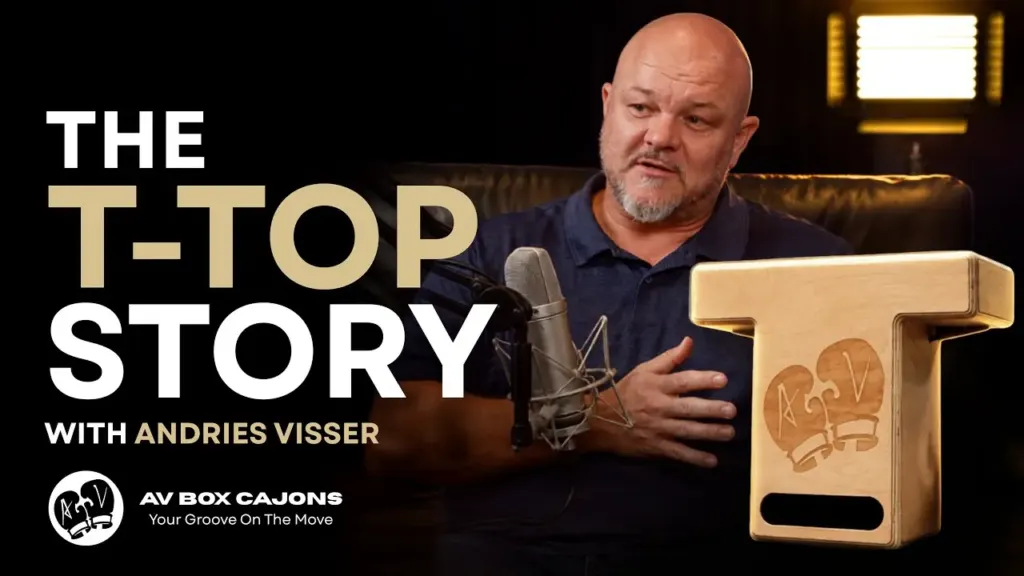
The AV Box T-Top does not look like any other cajon, and that is on purpose. In a 10-minute clip from his Dromers & Doeners interview, its designer Andries Visser tells the T-Top cajon story: the gig that started it, why he stopped building ordinary box cajons, and the design choices that give the T-Top its sound.
The T-Top cajon story in Andries’ own words
It started with a cajon he could not borrow
Andries wanted something smaller and easier to carry than a full drum kit. When he was booked for an acoustic set with Louis Brittz in Louis Trichardt, he needed a cajon and could not find one to borrow in time. So he bought wood, watched YouTube videos, learned woodworking on the go and built his first box.
That box got him through the gig, with swollen fingers and a quick dip in the ice bucket at the pancake stall during the break. Afterwards, a farmer in the audience asked to buy it.
Why he did not just build a better box
Over the next while Andries built 60 to 70 box cajons and listened closely to what musicians said about them. The feedback was mixed, and he realised he was reinventing the wheel. He was close to selling his tools when he looked at one of the boxes and asked a different question: how would a cajon feel on your lap?
A cajon that sits on your lap
That question became the T shape. The body is shaped so it sits comfortably on your legs, with your feet tucked underneath, and it is small enough to carry anywhere. The first version had a screwed-on top and sounded boxy, so it went back to the drawing board.
Glued, not screwed: where the sound comes from
An engineer friend modelled the design in Fusion 360, and the T-Top is now glued together instead of screwed. Gluing down the veneer playing surface was the big step: it took the drum from about 83dB to around 110dB of internal sound pressure, with far more low end.
Across the top surface you get low frequencies, a midrange and snare tones, and moving your hand changes the sound again. In total the T-Top gives more than 20 different tones, which is why it plays like a small drum kit under your hands.
A microphone made for one drum
For live sound, Andries and a friend developed an internal microphone, and after many failed attempts they had one that handles up to 120dB. Today that is the TTM-02, tuned to the T-Top so it sounds natural through a PA. Set-up takes under five minutes: plug in and play.
From patent to churches
Andries designed the T-Top between 2018 and 2019 and registered it as a patent in April 2019. When lockdown came and churches moved their services online, many of them bought a T-Top, and it has grown from there.
T-Top or box cajon?
| AV Box T-Top | Traditional box cajon | |
|---|---|---|
| How you play it | On your lap, feet tucked underneath | Sitting on top of the box, playing the front panel |
| Sound | Low end, midrange and snare tones across the top, 20+ tones | Bass in the centre, slaps at the top edge |
| Microphone | Optional TTM-02 mic built inside | Usually an external mic in front or behind |
| Weight | Under 5kg | Varies by model |
Frequently asked questions
Who invented the T-Top cajon?
South African drummer and educator Andries Visser designed the T-Top between 2018 and 2019 and patented it in April 2019. He still builds every one by hand in Roodepoort, Johannesburg.
Is the T-Top still a cajon?
Yes. It is a cajon reshaped into a T, so you play it on your lap instead of sitting on it.
Can children play the T-Top?
Yes. Children from about three years old can play it, because they can tuck their feet underneath and it weighs under 5kg.
Where can I watch the full interview?
The whole hour-long conversation is in our post Andries Visser on Dromers & Doeners.

Get the T-Top Full Combo
Everything you need to play the T-Top on stage: a handmade AV Box T-Top cajon in the veneer of your choice, the TTM-02 internal microphone and a padded carry bag. Built to order by Andries, with free delivery in South Africa.

